skip to main |
skip to sidebar
 If you own a piece of land right in the city center of Bangkok and do not have any idea what to do with it or no capital to invest yet, you could easily start making money while waiting by turning it into parking lots. Parking space is always in demand. Temporary and illegal parking can be found all over the city. Most of the time it happens under the new open space created by elevated expressways. The existing circulations of the neighborhood are erased by the monstrous structure. Paths and directions are unclear and rerouted everyday as these cars randomly occupy the space. This is an example to show that a size of parking lot may not need to be 2.4 by 4.8 meters. Whatever architectural standard would be thrown out of the window when it comes to necessity.
 When an urban superstructure cuts through a neighborhood, theoretically speaking, it physically breaks the neighborhood’s entity into 2 parts. But, in reality, it helps loosen up the tight built-up surface of the community. Space underneath the mega structure is commonly used as neighborhood’s communal area. Want to have a BBQ this weekend? Please RSVP early and BYOB!
 With a little effort and time invested on observation, interesting patterns of the space’s adaptive reuses reveal. First, in the morning, homeless people staying overnight occupied the area. Then, in the afternoon while the sun was blocked by the expressway above, the space turned into a playground. The type of sports and the area used were limited under the shade. Homeless moved further to the far end. Finally, in the evening after working hours, the number of participant increased and the activities continued till late at night because of the freedom of playing without getting conflict with traffic.
 The space underneath expressway is terrain vague. It is open, vast and empty, an untamed urban landscape welcoming all possibilities to take place. The new programs emerge here are usually temporary, haphazard and heavily dependent on their surrounding context.
 Nothing beats construction of superstructure when it comes to disaster on urban fabric, especially in Bangkok, a city where daily transportation heavily relies on private vehicles and whose authorities believe that building expressway is the answer to traffic problem. Buildings are torn down to give way to the structure and machineries used during construction process. In most cases, they are destroyed only half way or less, just enough to proceed the rushing construction. Some of the leftover structures are kept and new facades are built to reuse the spaces. Some are abandoned to be 'ghost buildings'.
 In general, when you want to construct something near this kind of massive infrastructure, a certain setback distance is required. How about the other way around? Is there any regulation on the setback of the new structure from existing buildings? In Bangkok, the insertion of superstructures into existing urban space is driven by necessity. In many cases, the existing space is just simply too tight to talk about noise pollution or aesthetic.
 Elevated expressway is believed to be a solution to traffic problem as it gets you from one point to the other faster. But the solution has been proved failure. Cars from the city’s periphery can move toward the city center faster while the number of cars at the center, at a particular moment, doesn’t decrease. Moreover, the gigantic size of these superstructures has caused difference in scale comparing to the size of local buildings. As more and more of these structures are, and will be, built, a new uninhabited urban layer is created over existing neighborhoods.
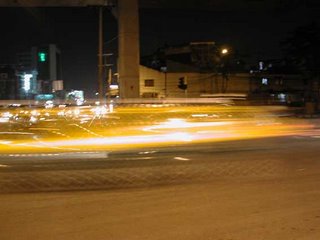 Bangkok is well known for its traffic condition. Inhabitants are in favor of private transportation. The amount of new cars keeps increasing everyday. With the registration number of new vehicle at about 1,000 cars a day (It was recorded as 1,220 cars/day in 1996) and the density ratio of road in length per area at only 2.55 km./ sq.km, no doubt Bangkok is brought to the forefront on the chart of world’s cities with serious traffic problem.